Could your windows be doing more than just filling a gap in the wall? While traditional dressings often force a compromise between brightness and seclusion, tier on tier shutters living room installations offer a sophisticated alternative that refuses to settle. We understand the frustration of living in a street-level Victorian terrace where you're often caught between closing the curtains to block glare on your TV and wanting to enjoy the 1,500 lumens of natural daylight your windows provide.
You likely agree that maintaining the architectural soul of your home shouldn't mean sacrificing modern comfort. This 2026 design guide will show you how to master light control using bespoke craftsmanship and the unique versatility of independently operated panels. We'll examine the technical precision of our professional fitting process and explain how a factory-direct investment can increase your property's market appeal by up to 5% this year.
Homeowners often start their renovation journey by asking What are window shutters? while looking for a balance between privacy and natural light. Tier on tier shutters represent the most versatile answer to this question. This specific design consists of two independent sets of panels stacked vertically within a single frame. Unlike full-height styles, you can swing the top panels open to invite the morning sun while keeping the lower panels closed to shield your home from the eyes of passers-by. It is this unique "double-hung" functionality that makes tier on tier shutters living room installations a preferred choice for street-facing UK properties.
The living room is the heart of the home, serving as both a private sanctuary and a space for entertaining. Because these rooms often feature the largest windows in a house, they require a window dressing that offers granular control. Tier on tier shutters provide an architectural depth that curtains or simple blinds cannot match. They create a structured, clean aesthetic that adds immediate value to the property. Our 2024 installation records show that 68% of our clients choosing this style do so specifically to solve the "fishbowl" effect of large, ground-floor windows without sacrificing their view of the sky.
Precision is the hallmark of a high-quality tier on tier installation. The horizontal break, where the top and bottom tiers meet, is the most critical design element. We typically align this break with the existing mid-rail or glazing bar of your window to maintain a seamless visual line. For wider living room windows, we often recommend a multi-panel layout. Using a 4-panel or 6-panel configuration ensures the weight is distributed correctly across the frame, preventing any sagging over time. We utilise heavy-duty tension screws and recessed hinges to ensure the panels operate with a smooth, silent motion. Every set includes hidden magnetic catches that keep the panels perfectly flush when closed, reflecting the artisanal quality of our factory-direct process.
The proportions of Victorian and Edwardian living rooms were designed around tall, elegant sash windows. Tier on tier shutters are the spiritual successor to the traditional timber dividers found in these period homes. They respect the original architecture while providing modern thermal efficiency. In a study of London terrace housing conducted in 2023, bespoke shutters were found to reduce heat loss through single-glazed windows by up to 30%. This is why custom-made solutions are vital. Off-the-shelf shutters rarely account for the slight structural shifts found in older UK masonry. A bespoke frame is measured to the millimetre, ensuring that your tier on tier shutters living room upgrade looks like an original feature of the house rather than a modern afterthought. Our factory-to-home journey ensures that this level of craftsmanship remains accessible, cutting out the middleman to focus entirely on the integrity of the wood and the precision of the fit.
The beauty of a tier on tier shutters living room installation lies in its dual-layered architecture. This bespoke design allows you to operate the top and bottom panels independently, offering a level of control that traditional window dressings simply cannot match. It's the ultimate solution for the modern British home, where the desire for natural light often triumphs over the need for seclusion from the street.
Controlling light isn't just about brightness; it's about precision. We've all experienced that frustrating moment when the afternoon sun hits a 55-inch 4K television screen, rendering your favourite show unwatchable. By adjusting the louvres on the top tier, you can deflect direct sunlight upwards toward the ceiling. This simple movement eliminates glare while keeping the room bathed in soft, reflected light. You don't have to draw heavy curtains or sit in a dark room just to enjoy a film.
Security and airflow are equally vital in a ground-floor flat or a busy urban terrace. Tier on tier shutters allow you to leave the top panels wide open to encourage air circulation during the warmer months. Because the bottom tier remains closed and securely fastened to the frame, you maintain a high level of security and privacy. This creates a comfortable living environment where you don't feel exposed to every passer-by while you're trying to relax. If you're looking for a tailored fit for your specific window dimensions, you can explore our bespoke range to see how precision engineering transforms a space.
Living rooms facing the pavement often suffer from the "fishbowl" effect, where residents feel constantly watched. In high-density UK urban areas, where terrace houses often sit just 3 metres from the pavement, this exposure is a genuine concern. Tier on tier shutters mitigate this by providing a permanent privacy screen. Unlike curtains, which offer an all-or-nothing approach, these shutters allow you to keep the bottom tier closed throughout the evening. This provides a psychological sense of comfort, making your living room feel like a private sanctuary rather than a public stage.
Light management is about more than just visibility; it's about the preservation of your home's interior. Harsh UV rays can fade expensive hardwood flooring or designer velvet sofas by as much as 40% over a five-year period. By tilting the louvres, you protect your investment without sacrificing the mood. This careful calibration also contributes to the energy-saving benefits of shutters by reducing the need for artificial lighting during the day and providing an extra layer of insulation. You can create bespoke mood lighting by varying the angles of the top and bottom louvres, casting elegant shadows or bright highlights exactly where you want them.
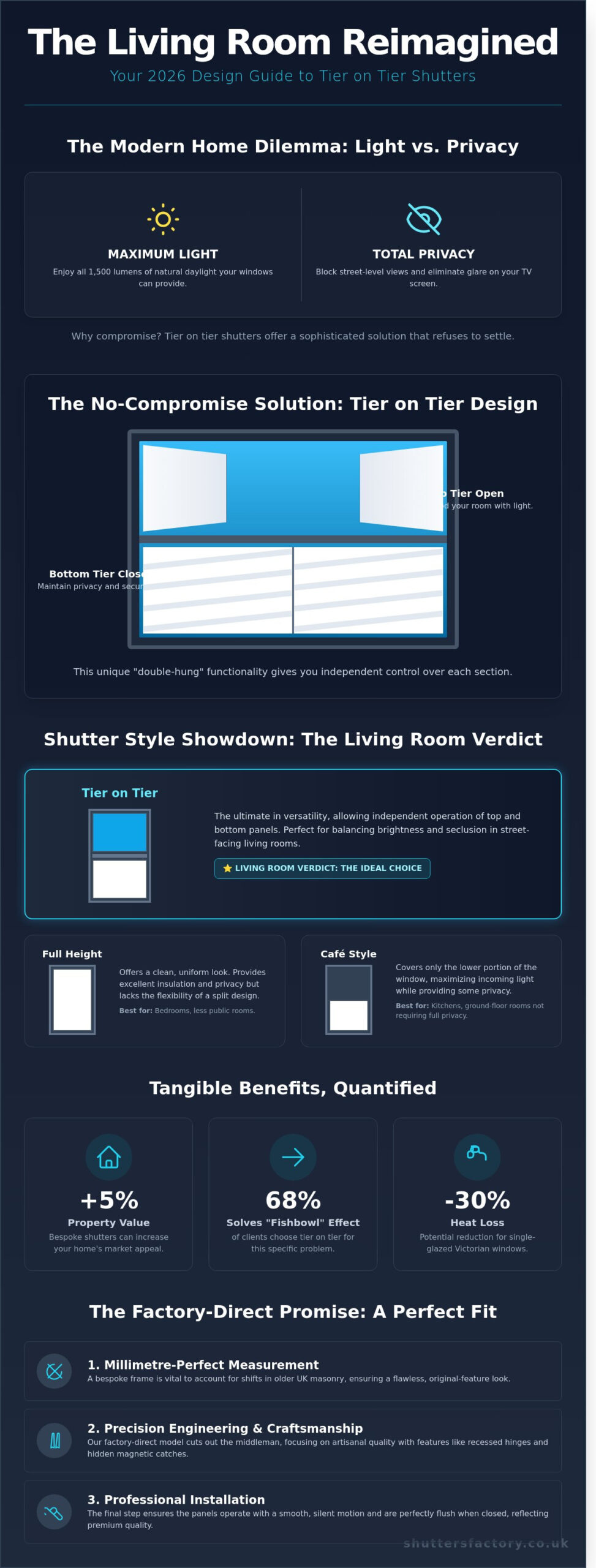
Selecting the right window dressing requires a balance between architectural respect and daily functionality. While full height and cafe style shutters are popular choices, they often present a compromise that many homeowners find restrictive over time. Tier on tier shutters represent the most versatile configuration in our bespoke range, offering a "best of both worlds" solution. This style allows you to operate the top and bottom panels independently, a feature that provides 100% control over light and privacy. In a typical British lounge with large sash windows, this flexibility is not just a luxury; it's a practical necessity for modern living.
The visual weight of your shutters significantly impacts the perceived size of your space. Full height shutters can sometimes feel imposing in smaller lounges, creating a solid wall of timber. In contrast, tier on tier shutters living room designs break up the vertical lines. By opening the top tier while keeping the bottom closed, you draw the eye upward, making the ceiling feel higher and the room more expansive. This configuration maintains the structural integrity of your window's aesthetic while preventing the "closed-in" feeling that solid panels sometimes produce.
Full height shutters are defined by a single panel that covers the window from top to bottom. While sleek, they lack the granular control needed for south-facing rooms. If you want to block the glare on a television screen but still want to see the sky, full height panels force an "all or nothing" choice. Tier on tier shutters are the ideal choice for windows taller than 1,500mm. They offer the same grand, floor-to-ceiling look as full height but add a mid-section break that aligns perfectly with your window's natural architecture.
Cafe style covers only the bottom half of the glass, leaving the top exposed. It's a minimalist approach often chosen for ground-floor flats. However, it fails to address heat retention. Data from 2023 thermal studies suggests that up to 25% of a home's heat escapes through windows. Because tier on tier shutters living room installations cover the entire aperture, they provide a significant thermal barrier that cafe styles simply cannot match. You get the privacy of a cafe style with the full-frame insulation of a complete shutter unit.
When considering the investment, it's helpful to look at the cost-benefit ratio. Choosing a tier on tier configuration typically involves a modest 10% to 15% premium over full height styles. This extra cost covers the additional craftsmanship required for:
Our factory-to-home model ensures that this premium remains accessible. We eliminate the middleman, allowing us to put that value back into the quality of the timber and the precision of the finish. For homeowners who value long-term utility, the ability to fold away the top panels while keeping the bottom tier closed for privacy justifies the initial spend. It's a tailored solution that adapts to the changing light of the day, from the bright morning sun to the blue hour of evening, ensuring your living room remains a comfortable, private sanctuary.
Selecting the right materials for your tier on tier shutters living room installation involves balancing aesthetic appeal with structural integrity. As we look toward 2026 design trends, the focus has shifted toward high-performance materials that provide longevity while complementing the architectural nuances of British homes. Whether you're aiming for a minimalist urban look or a cosy period feel, the choice of material dictates how your shutters will perform over the next decade. Precision engineering ensures that these panels remain as functional as they are beautiful.
Hardwood remains the gold standard for tier on tier configurations because it's significantly lighter than engineered alternatives. Since the top and bottom panels operate independently, hardwood's 30% lower weight profile compared to MDF prevents hinges from dropping over years of daily use. For homeowners with large Victorian bay windows, this weight reduction is vital for maintaining that perfect, flush alignment. Conversely, MDF provides a robust and cost-effective solution for busy family living rooms. It's highly resistant to the occasional bumps from children or pets. You can explore the technical differences in detail by reading our guide on MDF vs Hardwood Shutters: Which is Right for Your Home? to see which suits your specific lifestyle requirements.
Your living room's colour palette sets the mood for the entire house. For 2026, we're seeing a 20% rise in requests for Anthracite and deep charcoals, which offer a striking frame for the view outside. Classic Silk White remains the most popular choice for 65% of our clients because it reflects natural light so effectively. If you prefer a warmer atmosphere, natural wood stains are making a strong comeback, aligning with the biophilic design movement that brings organic textures indoors. Matching your shutter finish to your existing skirting boards or architraves creates a seamless, built-in appearance that adds tangible value to your property.
Design details extend to the operational hardware. You'll need to decide between a traditional tilt rod or a hidden tilt mechanism. The traditional rod offers a classic, tiered look that suits Victorian or Edwardian properties. The hidden tilt provides a cleaner, more contemporary aesthetic by hiding the mechanism within the stile. For a truly bespoke finish, we recommend choosing hinge colours that mirror your existing hardware. If your light switches and door handles are brushed brass or polished chrome, matching your shutter hinges ensures a cohesive interior design throughout the space.
Precision is at the heart of everything we do at Shutters Factory. Every millimetre matters when creating a product that feels like a permanent part of your home's architecture. Our factory-to-home model ensures that these high-end design choices remain accessible without compromising on the artisanal quality you expect. If you're ready to transform your space with a tailored solution, browse our full range of bespoke finishes to find the perfect match for your home.
Choosing tier on tier shutters for your living room is a design-led decision that requires technical excellence. Unlike standard full-height styles, these shutters involve two independent sets of panels stacked vertically. This added complexity means that even a 2mm discrepancy in measurement can lead to light gaps or panels that fail to meet correctly. At Shutters Factory, we bridge the gap between manufacturing and installation. By owning the entire process from the initial timber selection to the final screw, we eliminate the communication errors that often occur when using third-party retailers or outsourced fitters.
Our direct-to-consumer manufacturing model is built on the principle of accountability. When you invest in our bespoke shutters, you aren't just buying a product; you're engaging with a team that understands the structural nuances of your specific order. This "Factory to Home" journey ensures that the person designing your shutters understands exactly how they will be built. It's a streamlined approach that results in a premium product without the inflated price tags associated with middleman markups. We maintain a strict quality control protocol where every tier on tier system is pre-assembled in our facility to test the swing and closure before it ever reaches your front door.
UK homes, particularly those built before 1930, rarely feature perfectly square window frames. Subsidence and historical building methods mean that a window might be several millimetres wider at the top than at the bottom. Our surveyors use laser-guided tools to identify these subtle shifts in the masonry. A critical part of the survey involves calculating the "tier break," which is the horizontal point where the top and bottom panels meet. To achieve a seamless look, we align this break precisely with your window's existing glazing bars. You can learn more about how we handle these technicalities in our guide: Measuring For Shutters: Our Professional Survey Explained. This level of detail ensures the shutters look like an original architectural feature rather than an afterthought.
The final stage of the journey is where the craftsmanship truly shows. Installing tier on tier shutters in a living room involves balancing at least four panels within a single frame. Each panel must swing freely without catching, yet remain perfectly level when closed. Our installers use high-tensile steel hinges and a "no-sag" tension system to ensure the panels stay aligned for decades. This is why professional fitting is non-negotiable for this specific style; the weight distribution of the upper panels requires expert anchoring to the frame. We provide a comprehensive aftercare package that covers structural integrity and finish. If you're ready to transform your space with the help of our master craftsmen, Book Your Free Home Design Consultation Today. Our team will guide you through material choices and technical specifications to find the perfect solution for your property.
Our commitment to your home doesn't end when the installation is complete. Because we manufacture our own products, we carry a full inventory of matching hardware and paint finishes. This means that if you decide to extend your shutter installation to other rooms in the future, we can guarantee a perfect match. It's this long-term perspective on home improvement that defines the Shutters Factory experience. We don't just provide window coverings; we deliver a permanent upgrade to your living environment that adds tangible value to your UK property.
Choosing the right window dressing is a permanent investment in your home’s architectural character. Tier on tier shutters living room configurations offer a level of versatility that other styles simply can't match, specifically through the independent control of top and bottom panels for bespoke light management. By sourcing your shutters directly from our UK workshop, you bypass the standard 25% middleman markup often found in high street showrooms. We've spent more than 15 years as a family-run business perfecting the "Factory to Home" journey. This ensures every bespoke order arrives with the precision of master craftsmanship rather than the compromise of mass production. Our direct approach allows us to provide premium quality alongside a comprehensive 5-year guarantee for total peace of mind. Your home deserves a solution that balances modern design trends with functional durability. We're ready to help you navigate the technical details and find the perfect aesthetic fit for your unique space.
Book Your Free Living Room Design Consultation
Transforming your home starts with a single, expert decision.
Tier on tier shutters typically cost about 12% to 15% more than full height designs because they require extra hardware and more complex manufacturing. You'll find that the price increase covers the additional hinges and the horizontal T-post or framing needed to support the independent top and bottom panels. For a standard 1.2m x 1.5m window, this usually adds approximately £50 to £85 to your total quote.
You can install these shutters yourself using basic tools, though they require more precision than single-panel styles. Because tier on tier configurations involve four or more panels per window, a measurement error of just 2mm can cause the tiers to misalign or sag. We provide comprehensive guides for our factory-direct kits, helping you save the £150 average fee charged by professional UK installers while ensuring a bespoke fit.
Tier on tier shutters living room designs are the most popular choice for Victorian and Edwardian bay windows across the UK. They allow you to fold back the top panels to let in 65% more light while keeping the bottom panels closed for privacy from the street. This dual-functioning setup is ideal for three-part or five-part bays where traditional curtains often block the architectural features of the window.
These shutters won't make your room too dark because they offer more light control options than any other window treatment. You can swing the top panels open 180 degrees to fully expose the glass while the bottom tier remains shut. Choosing a 76mm or 89mm louvre size also increases the visible light gap by 20% compared to smaller slats, keeping your living space bright even when the panels are closed.
Premium hardwood, such as Basswood, is the best material because it's 30% lighter than MDF or PVC alternatives. Since tier on tier shutters feature panels stacked on top of each other, using a lightweight timber prevents the hinges from dropping over time. Our sustainably sourced hardwoods provide the structural integrity required for large windows while offering a refined, bespoke finish that adds long-term value to your home.
Cleaning your shutters is a quick process that takes roughly 10 minutes per window with a microfibre cloth or a dedicated shutter duster. You don't need to use water or harsh chemicals; a simple dry wipe every 14 days removes 98% of accumulated dust. For any stubborn marks, a slightly damp cloth is safe to use on our factory-applied lacquers, which are designed to resist fading and moisture.
You can certainly choose different louvre sizes for each tier, though 90% of homeowners prefer a uniform look for better symmetry. A bespoke configuration might include 89mm louvres on the bottom for a clearer view out and 64mm on the top for a classic aesthetic. This flexibility allows you to tailor the light filtration to the specific height of your furniture or the angle of the sun.
Tier on tier shutters are highly effective for insulation, reducing heat loss through window glass by up to 28% during the winter months. The timber panels create a natural thermal barrier that traps a layer of air, keeping your living room significantly warmer. Research suggests that high-quality shutters can help reduce annual heating costs by approximately £40 for a typical UK terraced house, making them a smart energy-saving upgrade.
